★★★★★“We increased our patient visits”
★★★★★“Our staff loves it!”
★★★★★“Super easy to use”

Keynotes & CE Sessions for Chiropractic Associations

Your members are already using AI. Almost none of them are using it compliantly.

Naota Hashimoto, DC has 17 years in practice and sees live data from more than 1,000 chiropractic practices — a working pulse on where the profession actually is, not where anecdote says it is. He turns that data and the peer-reviewed literature into board-ready CE on AI compliance, treatment plan adherence, and patient communication. TrackStat supports every session, so it costs your association nothing.

No Speaker Fee No Travel Cost Syllabi Ready for Board Submission 60 / 90 / 120-Minute Formats
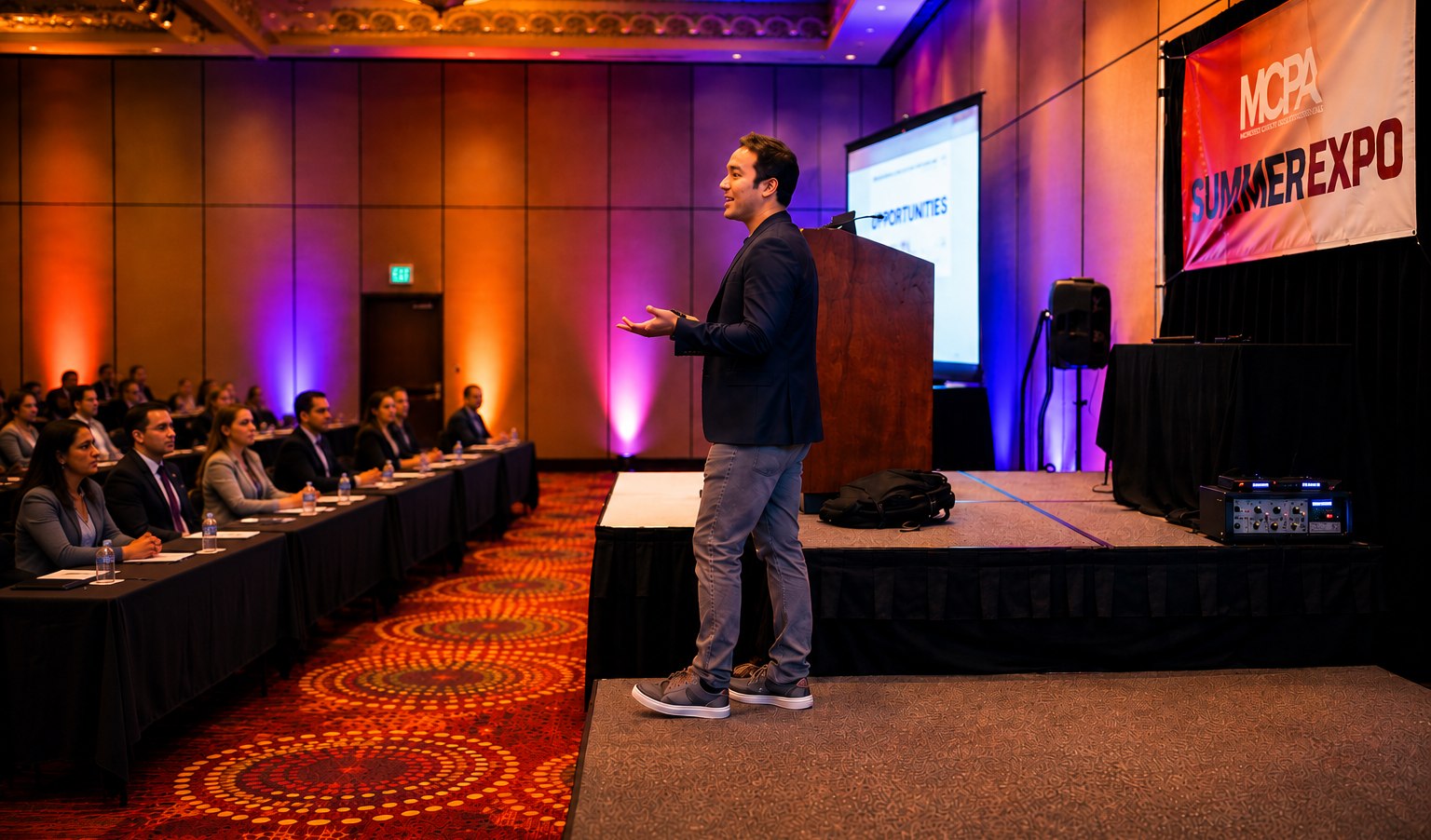
Naota Hashimoto, DC presenting to a seated audience at the MCPA Summer Expo
On stage Presenting at the MCPA Summer Expo
17Years in practice as a treating chiropractor
1,000+Practices feeding the data behind every session
3Board-ready CE courses across separate tracks
$0Cost to the association — sponsorship covers it

Hear him present before you book him

Speaker Introduction

Why this, why now

Everything costs more. AI is how a practice does more with the team it already has.

Payroll is up. Rent is up. Supplies, insurance overhead, and the cost of every hire are up. For most of your members, adding another front desk person is not the answer — and in a lot of markets they cannot find one anyway.

This is why AI adoption in healthcare is accelerating so quickly. Voice AI answers the phone that would otherwise ring out, books and reschedules the appointment, runs intake, and drafts documentation. Used well, it does not replace anyone. It hands time back to the staff you already have — so a CA can chase down the claim that has been sitting for 60 days, work the reactivation list, or simply be present with the patient standing at the front counter instead of apologizing for the phone.

That is the upside, and it is real. The problem is what comes with it. The moment a patient's voice becomes data, HIPAA applies — to how it is captured, where it is stored, who it is transmitted to, and what a vendor is permitted to do with it. Most doctors running these tools today have never asked for a Business Associate Agreement, could not say where their recordings live, and have no safeguards in place.

There is no shortage of people selling AI to your members. There is a real shortage of people teaching them how to run it without creating a HIPAA exposure.

Available sessions

One speaker, three slots on your agenda

Every session draws on the same two sources: real operating data from more than 1,000 practices, and the peer-reviewed literature. Each course fills a different track, so a single travel arrangement can cover your technology, clinical, and staff programming. Full syllabi with learning outcomes, agendas, prerequisites, and disclosures are available on request for board submission.

Technology & Compliance Track

Voice AI in Healthcare: Clinical Applications, Workflow Efficiency, and HIPAA Compliance

60 Minutes Live Lecture Pre & Post Knowledge Checks No AI Background Required

AI adoption in healthcare is growing fast, and the reason is economic. Every cost in a practice is rising while staffing gets harder, and AI is the first tool in a generation that lets a clinic absorb more volume without adding headcount. This session starts there — with the actual workflow math — before turning to the part almost nobody is teaching.

Attendees see where Voice AI genuinely earns its place: answering and triaging calls, booking and rescheduling, running intake, generating documentation and SOAP notes, and handling reminders and recall. The framing throughout is that automation should buy back staff time, not eliminate staff — time that gets redirected into insurance claim follow-up, patient reactivation, and the in-office experience that actually drives retention.

The back half is compliance, taught by someone who works inside the data every day. What counts as Protected Health Information once a patient speaks. How voice data is captured, stored, and transmitted, and who touches it along the way. What the HIPAA Privacy and Security Rules actually require of an AI vendor. Why a Business Associate Agreement is non-negotiable, and how to tell a compliant vendor from one that simply says it is. Attendees leave with a vendor evaluation checklist and a safeguards list they can apply to the tools already running on their front desk.

Presentation slide titled Risks of AI in Healthcare, covering PHI involvement, data processing and security, potential liability, and the importance of HIPAA compliance
Sample slide From the risk-and-liability segment of the session

Learning outcomes

  • Define Voice AI and describe its primary applications in healthcare settings
  • Identify use cases across documentation, patient communication, and administrative workflow
  • Quantify where automation returns staff hours and how that capacity is best redeployed
  • Explain core HIPAA Privacy and Security Rule requirements as they apply to voice data
  • Recognize the risks AI tools introduce in data storage, transmission, and third-party access
  • Evaluate whether a Voice AI vendor is HIPAA-compliant, including the role of a BAA
  • Implement basic safeguards that reduce compliance risk in a live practice
  • Distinguish compliant from non-compliant Voice AI use through applied case scenarios
Clinical & Evidence Track

Can Treatment Plan Adherence Correlate With Better Outcomes? Evidence-Based Insights

60–120 Minutes Live Lecture Opening Adherence Quiz Technique-Neutral

Chiropractors disagree about technique. They do not disagree that a patient who finishes a plan of care does better than one who stops at visit four. This session is built on that common ground, and it is deliberately technique-neutral.

The premise is simple and it cuts both ways: better adherence produces better patient outcomes and better practice outcomes. Those are not competing goals. A patient who completes care holds function longer and returns with fewer latent flare-ups. A practice whose patients complete care sees more visits per case without adding a single new patient. The same behavior serves both.

Getting there takes more than a better recommendation. The session pairs the evidence — Mercy guideline visit ranges, the utilization and cost research showing chiropractic adherence reduces overall spend (PubMed 35606781), and the reality that musculoskeletal conditions remain the leading cause of disability worldwide — with the research-backed psychology of why patients quit early and what makes them stay. Attendees learn how to help a patient see a concrete better future for themselves and genuinely want to move toward it, rather than being talked into a schedule they never bought into.

From there it turns operational: how to audit your own treatment plans against published guidelines, how to run a team meeting on new and non-progressing patients, what the administrative team must know about visit frequency and progress-exam timing, and how to measure progress in a way patients can see. It is a balance of research, psychology, practice data, and growth — with better patient outcomes as the mechanism, not the marketing.

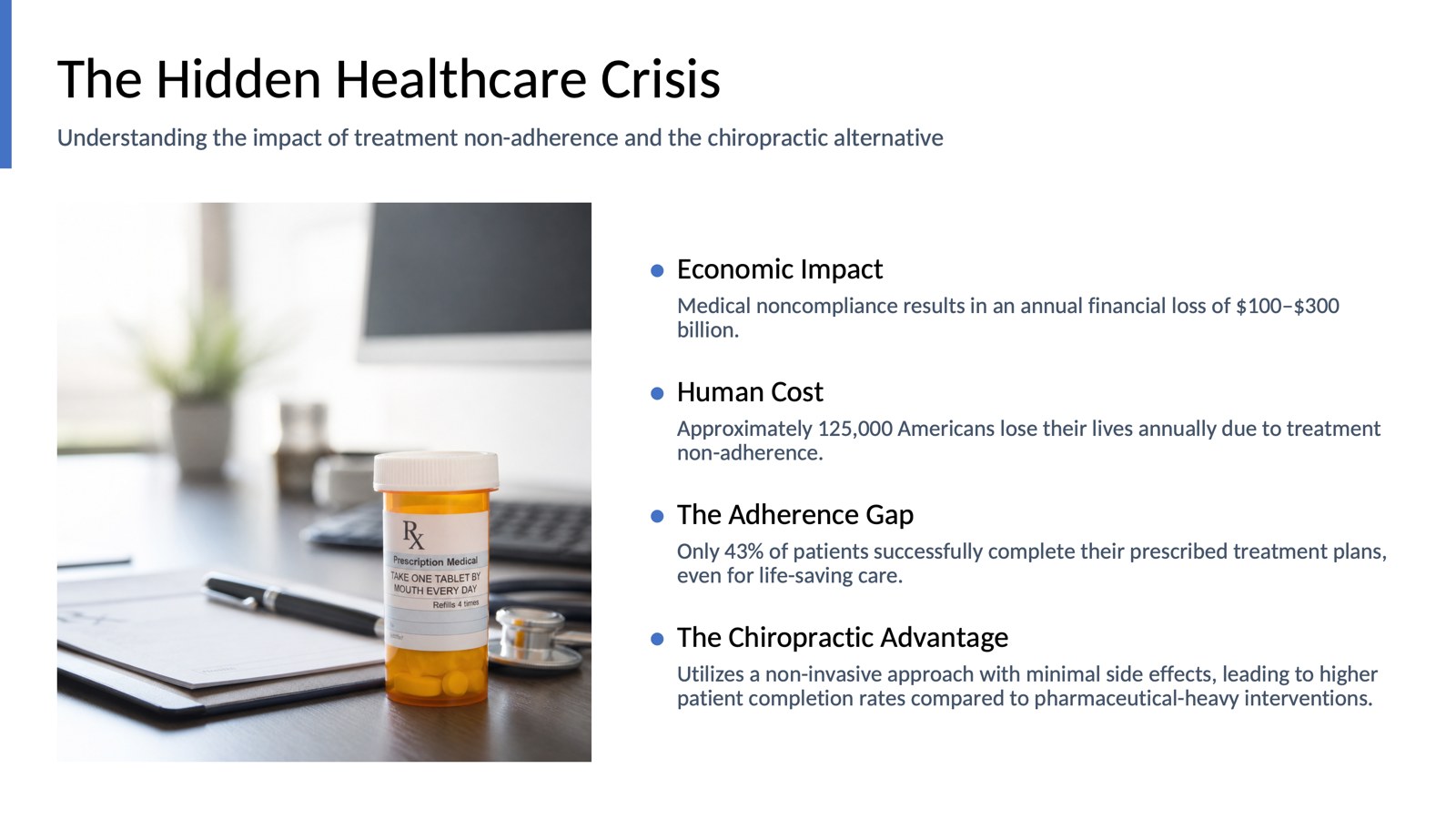
Presentation slide titled The Hidden Healthcare Crisis, covering the economic impact, human cost, and adherence gap of treatment non-adherence, and the chiropractic alternative
Sample slide From the opening segment on the cost of non-adherence

Learning outcomes

  • Explain why the entire team must understand the doctor's treatment plan and what it contains
  • Describe how a recurring team meeting on new and non-progressing patients improves outcomes
  • Identify what the administrative team needs to know about visit frequency and progress-exam timing
  • Apply research-backed psychology that helps patients envision a better outcome and commit to it
  • Justify the clinical and financial case for measuring patient progress
  • Perform a self-audit of existing treatment plans against published guidelines
  • Relate adherence rates to both patient outcomes and practice performance
  • Apply plan-adherence principles to insidious-onset chronic low back pain

Practice & Team Track

The A.L.I.G.N. Framework: Structured Communication for Patient Engagement

60–90 Minutes Live Lecture Doctor & CA Friendly

Patients rarely leave care because the adjustment failed. They leave because of what happened around it — a barrier never surfaced, a plan never made concrete, a plateau never explained. Across 127 studies, patients whose physician communicates poorly carry a 19% higher risk of non-adherence, and communication training raises the odds of adherence by a factor of 1.62 (Haskard Zolnierek & DiMatteo, Medical Care, 2009). Communication is not a soft skill here. It is a measurable determinant of whether a plan of care gets finished.

The session opens with what actually drives patient dissatisfaction — scheduling friction, waiting, feeling rushed, cost confusion, and above all the absence of active listening and empathy — and ties each to published work. Clinicians interrupt a patient stating their concern after a median of 11 seconds (Singh Ospina et al., Journal of General Internal Medicine, 2019); it was 18 seconds when Beckman and Frankel measured it in 1984. Satisfaction tracks the time a patient believes they received more closely than the minutes actually elapsed (Lin et al., Archives of Internal Medicine, 2001). Nonverbal behavior — eye contact, body orientation, attentive posture — significantly predicts satisfaction (Henry et al., Patient Education and Counseling, 2012).

It then turns to the forces that decide what a patient does after leaving the room. Practical support outweighs encouragement: across 122 studies, patients without tangible support carried nearly twice the risk of non-adherence (DiMatteo, Health Psychology, 2004). Commitment works when the patient makes it themselves — having patients write their own appointment time rather than a staff member writing it cut no-shows by 18% in a UK general-practice study (Martin, Bassi & Dunbar-Rees, Journal of the Royal Society of Medicine, 2012). A.L.I.G.N. organizes these findings into five stages a doctor can hand to their CAs on Monday morning.

It closes outside healthcare, on what a chiropractic front desk could borrow from Chick-fil-A: anticipatory service, consistent scripting, and throughput that never leaves the guest feeling hurried — offered as an operational analogy, not as evidence, and identified that way in the session.

  • AAttract with AuthorityEarn the right to be believed before you ask for anything.
  • LListen and LabelName the real barrier out loud — cost, time, fear, a past provider.
  • IIllustrate the PlanMake the plan concrete: what, how often, for how long, and how you will know.
  • GGain CommitmentAsk for an explicit yes and document it.
  • NNormalize the JourneyFrame plateaus and flare-ups as expected, not as failure.

Evidence baseHaskard Zolnierek & DiMatteo, Med Care 2009;47(8):826–34 · Beckman & Frankel, Ann Intern Med 1984;101(5):692–6 · Singh Ospina et al., J Gen Intern Med 2019;34(1):36–40 · Lin et al., Arch Intern Med 2001;161(11):1437–42 · Henry et al., Patient Educ Couns 2012;86(3):297–315 · DiMatteo, Health Psychol 2004;23(2):207–18 · Martin, Bassi & Dunbar-Rees, J R Soc Med 2012;105(3):101–4 · Gollwitzer & Sheeran, Adv Exp Soc Psychol 2006;38:69–119. Framework structure adapted from consultative-communication research made famous by SPIN Selling.

Learning outcomes

  • Describe the five stages of the A.L.I.G.N. framework and the published research supporting each
  • Identify the leading drivers of patient dissatisfaction: scheduling friction, waiting, feeling rushed, and confusion about cost
  • Explain how active listening, empathy, and nonverbal behavior measurably affect satisfaction and adherence
  • Establish clinical authority in the opening minutes of a new patient encounter
  • Use reflective listening and labeling to surface a patient’s actual barrier to care
  • Present a plan of care so its structure and endpoint are understood before cost enters the conversation
  • Apply commitment and social-support findings that predict whether a patient follows through
  • Normalize plateaus and flare-ups so patients continue care instead of self-discharging

What it costs your association: nothing

TrackStat supports these courses so that state associations, districts, and chapters can add current, board-ready CE without touching the convention budget.

Speaker fee
None. There is no honorarium and no minimum attendance requirement.
Travel & lodging
Covered by TrackStat. No reimbursement request will come back to you.
Materials
Syllabi, handouts, and pre/post knowledge checks provided digitally at no charge.
What we need from you
A projector or large display, a lavalier or handheld microphone, and a confirmed session length.
Disclosure of Commercial Support These courses are supported by TrackStat, of which Dr. Hashimoto is a co-founder. Content is educational and non-commercial. No product is sold, demonstrated, or promoted from the podium, and no vendor content appears in the slides. Full written disclosure language is available for your CE provider's submission packet.
Naota Hashimoto, DC

Naota Hashimoto, DCChiropractor, co-founder of TrackStat, and 17-year practice owner.

About the speaker

Naota Hashimoto, DC

Dr. Hashimoto came to chiropractic as a patient first. After recovering from a head-on collision through chiropractic care, he built a career around a single question: what actually makes a patient get better and stay better?

Seventeen years of practice answered part of it. He built a multi-million-dollar practice in La Quinta, California, and learned what most doctors learn the hard way — that the best adjustment in the world does not help a patient who stops coming in at visit four.

He co-founded TrackStat to answer the rest of it at scale. The AI automation suite for chiropractic EHRs now runs in more than 1,000 clinics nationwide, which gives him something rare in this profession: a view of how thousands of practices actually communicate with patients, handle their data, and hold onto plans of care. That vantage point is where these sessions come from.

His stated mission is unglamorous and specific — help chiropractors run more profitable practices, raise the median income of the profession, and make it easier for the next generation to choose chiropractic at all.

Book a session

Fifteen minutes to see if it fits your program

Tell us your dates, your expected room, and which track you are trying to fill. If one of these sessions is right for your members, we will send the syllabus and disclosure language your CE provider needs the same week.

Naota Hashimoto, DC drhashimoto@yourtrackstat.com Office (760) 334-5013